

All Tasmanian politicians signed up to a civility pledge, now we must live it
In recent weeks there have been renewed calls for civility in our Parliaments, in public debate and, perhaps most urgently, online. Some of those calls have come from my own colleagues in the Tasmanian Parliament, and I welcome them. But we do not need a new pledge. We already made one.
In December 2025, Members of the Tasmanian Parliament publicly affirmed in our respective Houses a commitment to the enforceable standards of a new Code of Conduct. That commitment did not expire when Parliament rose for Christmas, and it does not lapse when politics gets heated. It still stands. Our task now is to focus on it, and to hold ourselves and each other to it.
The Code is far more than a statement of good intentions. Its preamble recognises something too easily forgotten: the actions of Members affect every Tasmanian, not only through the laws we pass but through the behaviour we model. When MPs treat one another or those in our community, with contempt or disrespect, we signal to the community that contempt and disrespect are acceptable ways to settle disagreement. When we disagree well, we show the opposite.
The Code commits Members to respect, integrity, honesty, openness, accessibility, objectivity, selflessness, leadership and accountability. It acknowledges that people hold different cultural and religious beliefs and diverse identities. It accepts that differences of opinion are part of political discourse, but asks that they be expressed respectfully. That is the heart of it. Civility is not about agreeing. It is about how we disagree.
Importantly, the Code applies at all times to Members of both Houses, including Ministers and Presiding Officers, in their capacity as Members of Parliament. Even in the chamber, where freedom of speech is protected, we are asked to be mindful of its principles, particularly respect for others and the right of everyone, including other Members, to a safe workplace.
Part II of the Code is enforceable. A failure to comply can lead to a formal complaint and a finding of breach. Members are not to engage in discrimination, bullying, harassment, sexual harassment or assault, or victimisation in the parliamentary workplace. We must take appropriate steps to protect our staff if we see or receive a report of unacceptable behaviour towards them, and we must act on allegations made about our own staff.
Then there is online behaviour, where much of the current concern lies. Here the Code is explicit. Members must be open, honest and transparent in their use of social media and other online activity, including artificial intelligence. We must not use social media, messaging services, email or any other online platform in a way that breaches our commitment to a safe and respectful workplace. And we are accountable for what our staff post when we authorise them to act on our behalf.
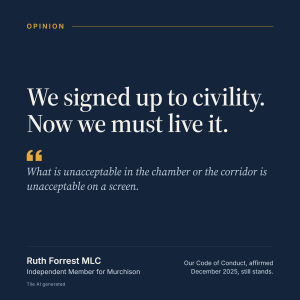
In other words, there is no “my social media adviser posted it” defence. What is unacceptable in the chamber or the corridor is unacceptable on a screen.
This matters because online platforms are now where many Tasmanians encounter their elected representatives. A post takes seconds to write and can travel far beyond its intended audience. The pile-on, the deliberate misrepresentation, the personal attack dressed up as political commentary: these corrode public trust and make public life less safe. They fall hardest on women, young people and people from diverse backgrounds. If we want good people to stand for office, we must make public life a place where they can do so without being torn down.
There are also safeguards in the Code. For example, a Member must not make a complaint against another Member without reasonable grounds, and must not make one that is frivolous or vexatious. Our Code of Conduct must never become a weapon in the political contest, rather it is the agreed standard of behaviour.
We have the framework and what it now requires is consistent leadership. That leadership falls to each of us. In calling for civility we must also examine our own posts, our own interjections and our own tone when we are frustrated or under pressure. I include myself in that. More than two decades in Parliament have taught me that the robust contest of ideas is essential to good law-making, and that it is entirely possible without personal denigration.
Tasmanians expect their Parliament to argue hard about the things that matter: health, housing, energy and the state of our finances. They do not expect, and should not have to tolerate, behaviour from their representatives that would not be accepted in any other workplace.
We put our names to this Code. We stood in our Houses and affirmed it. The full Code is available on the Parliament of Tasmania website for anyone who wants to read what we promised. I encourage every Tasmanian to read it, and to hold us to it.