

The Truth behind Tasmania’s Budget.
For years Treasury has warned that Tasmania is heading toward a fiscal abyss and that only a balanced mix of restraint, revenue measures and structural reform could avert it.
The Government ignored that advice, choosing instead a three‑year dash to peak debt built solely on spending cuts, uncosted operational efficiencies, and wilful omissions – including no policy plan and no provision for redundancy costs.
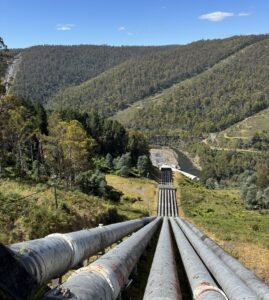
But the second important pillar of the Government’s fiscal turnaround and the one buried deep in the Budget papers, is even more fragile. It is the miraculous transformation of Hydro Tasmania’s profits, from near zero in 2024‑25 to a staggering $515 million in 2029‑30, the final year of the forward estimates. The first step, the current year 2025-26, is likely to see only half the budgeted profit of $73 m achieved so it’s not an encouraging start.
Hydro pays 93% of its underlying profit to the Government via dividends and tax‑equivalent payments. That means almost all of this projected windfall flows straight to the Budget bottom line. But it also means Hydro must borrow to upgrade and maintain its ageing dams and generation assets. This means Hydro must borrow even more if new renewable generation is required to be brought on through power purchase agreements (PPAs) with Hydro.
And new generation will be required, because the Marinus Whole‑of‑State Business Case assumes it. How it was to be funded was never disclosed. It was simply assumed to happen. But existing wind farms are unprofitable without Hydro’s assistance, through the existing PPAs which impacts its bottom line.
At estimates week we finally learned the truth: the surge in Hydro profits across the forward estimates has nothing to do with Marinus Link. Not one dollar.
This is the single most important budget revelation of the week. The Government’s long‑promised $470 million annual Marinus dividend does not appear in the forward estimates because it does not begin until after 2031‑32. The entire profit surge the Government is relying on – the 14‑fold increase – is driven solely by Basslink becoming regulated, and the Victorian wholesale prices rising as coal exits.
In other words, the Budget is being propped up by Basslink – an interconnector that is constrained and cost the State millions before its previous owner failed is now expected to rescue us and restore the budget position.
And this is where a deeper realisation finally becomes unavoidable. For years, the Government blurred two entirely different concepts: the consumer benefits of interconnection, which occur when cheap mainland power flows south and lowers Tasmanian prices, and the generator benefits to Hydro, which arise only when Tasmanian prices rise – not when Victorian prices rise. These outcomes come from different models, different mechanisms, and they benefit different people.
At Estimates, the Government finally admitted this, if you listened carefully.
Minister Duigan confirmed that Hydro is always settled at the Tasmanian price. It never receives the Victorian price or the price spread. All interstate trading proceeds flow into two settlement pools – one for imports and one for exports – and Hydro receives none of the residues unless it buys settlement residue units at auction. Treasury then confirmed the Budget did not model the cost of buying those units, even though this was once presented as the source of Hydro’s export windfall.
The auction proceeds are paid to the networks at either end. In Tasmania’s case that’s TasNetworks. But the catch – the part the Government never volunteers – is that the importing region receives the lion’s share of each pool. That means the export pool created by Tasmanian exports, when prices are higher, will be received predominantly by the Victorian network and passed on to Victorian consumers.
Despite this, the Government informed us they did no modelling of residues, directional pools, allocation rules, who captures export value, the cost of underwriting new renewables, or the risks Hydro must take to bid for residues. The Whole‑of‑State Business Case assumed zero inter‑regional revenue. Treasury confirmed it. Minister Duigan did not dispute it.
So how does Hydro profit from higher Victorian prices?
The Government now says the quiet part out loud: with greater interconnection, Tasmanian and Victorian prices will merge. When Victorian prices rise, Tasmanian prices rise. Hydro earns more because Tasmanian prices rise. Tasmanians pay more because Tasmanian prices rise.
Hydro’s profit uplift is not export revenue. It is money extracted from higher local prices, prices that will be passed on to Tasmanians as prices converge.
And even that uplift is uncertain. The Treasury Secretary admitted: “…we did stress-test their pricing modelling at that time. We didn’t get the same outcomes, but got similar outcomes, so I’m surprised by the results they have put forward through their input to the budget process.” Translated: Treasury’s modelling produced lower profits. Treasury did not validate Hydro’s numbers. Treasury does not understand how Hydro got to the Budget figures.
With a fiscal plan built on two very shaky pillars: operational efficiencies that departments cannot deliver, and a Hydro profit surge that Treasury is surprised by and that relies on Tasmanians paying higher prices.
The Budget has many gaping holes – it is not a plan. It’s a sham.