

Legislative Council, Wednesday 3 December 2025
The video recording of this speech can be viewed on the Parliamentary website at the link below (click on the Broadcast tab, and start at the 1:02 mark) If you are viewing this on a mobile device, you will need to click on the three dots on the right hand side when the link opens to see the Broadcast tab.
Or on Youtube:
Ms FORREST (Murchison) – Mr President, I will state clearly at the outset my position on Tasmania’s AFL team to ensure all who may be listening now, or reading this a later time, who may wish to quote me in or out of context, that I will be clear about my position: I fully support our own Tasmanian AFL team. I come from the north‑west of Tasmania, which has a deep and lasting tradition of AFL football. I’ve played the game myself, many years ago now.
I’m a proud foundation member of the Tasmania Devils AFL Club and a paid-up member and supporter of North Melbourne, our record‑breaking women’s team no less ‑ not so much could be said about the men, but the women are absolutely amazing. I’ve been to many AFL games in Hobart, Launceston, Melbourne, Sydney, Adelaide Oval and the Optus Stadium in Perth. I’ve been to Optus only once, but I’ve been to the others more than once.
I support the construction of a new purpose‑built stadium, a facility with sensitive design, community support and limited financial risk to the public purse. I recognise the need for high‑quality facilities for elite sport alongside genuine support for grassroots sport for all Tasmanians and I want to see a new purpose‑built facility delivered.
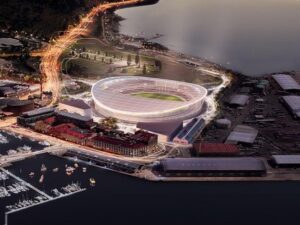
Today’s decision concerns whether a particular development on a particular site using a particular funding model meets the standard we should apply to major infrastructure in this state. We are being asked today to consider whether or not to support the order that will facilitate the construction of a specific, new, 23,000 seat fixed‑roof stadium at Macquarie Point as per the agreement with the AFL, signed by the Premier on our behalf.
This was when the real division started. Premier Rockliff signed this deal containing many onerous provisions with no consultation with key stakeholders.
The parliament agreed to refer this planning decision to the Tasmanian Planning Commission – not a measure I supported, but the parliament supported it, so I support it and accept it and weighted their findings. These qualified professionals applied established planning principles. Whether you agree with their decision or not, their conclusion was unambiguous: the costs outweigh the benefits, the development is too large for the site, and it would impact this area’s critical and important heritage values. This is a professional planning assessment delivered through processes that exist to evaluate development proposals objectively.
The order before us proceeds despite these findings. Parliament is supreme, and absolutely we can make this decision. However, we should understand what we are deciding: whether to approve a development that professional planners have determined does not meet planning standards.
I acknowledge the work that’s been done by the government and MPDC and the huge cast of thousands that are working on this. I finally met a number of them on Monday this week, late in the day, to understand a lot of the work that’s gone on with the project. I commend them; they’ve done a huge amount of work.
I will go back to the point I wish to really focus in on. The government’s fiscal strategy No. 9, published in the November 2025‑26 Budget requires that 100 per cent of government‑owned business infrastructure projects exceeding $50 million must have a positive benefit-cost ratio. This is the government’s own fiscal strategy. This ensures money is invested productively and appropriately. The stadium has a cost‑benefit ratio of approximately 0.5, returning only 50 cents in benefit for every dollar invested.
This is not to say, though, that an infrastructure investment that does not have a positive cost‑benefit ratio should never be built, as clearly this would mean some critical infrastructure would not pass the test. The test is: is this critical infrastructure, and are there other options? The stadium itself – is this critical infrastructure, and are there other options?
Macquarie Point Development Corporation is a government‑owned statutory authority. The question is therefore unavoidable. If the government holds its own businesses to this standard, why would it not apply to this project? That is a question that’s yet to be answered. This is not about vision versus fiscal prudence; it’s about consistent application of the government’s own investment criteria for its own businesses – our businesses.
Tasmania faces significant fiscal challenges. As I detailed recently and warned of for many years, we’re heading toward $20 billion in total government debt. We had zero economic growth in the last financial year, international exports declined 4.4 per cent, and our underlying net operating balance shows a $1.4 billion deficit this year.
Treasury’s fiscal sustainability report states that ‘incurring debt to fund recurrent expenditure is not considered beneficial or sustainable.’ Yet, that’s what we’re doing. We’re currently borrowing to pay for operating costs. The costs of delivering services, public sector service wages, health system operations, education, public safety, to name a few – we’re borrowing to pay for those.
The Treasurer himself posed the right question, in my view, in a recent ABC Stateline interview when he said:
Can you look down the barrel of a TV camera and say to your fellow Tasmanians, is this an expenditure so worthy that you are willing to make the next generation pay for it?
I think it’s a very good question he asked. He added:
If you are talking about operational expenditure so that we can have a better lifestyle today at the expense of the next generation, that is where it is not only an economic argument but also a moral argument, and I think it’s unfair to the next generation.
Those are his words, but this is actually what we are currently doing right now. This is a reality into which this decision must be made. You cannot separate them and pretend one doesn’t exist without the other. These are serious economic and moral principles. When we apply this test to the stadium, a discretionary expenditure, we must also consider whether future generations will pay debt-servicing for decades, perhaps $1.8 billion over 30 years, while receiving an asset that’s likely to be worth half what was spent.
To be very clear, the stadium does not and will not eliminate our fiscal challenges, even if it is rejected. Taking it out of the mix will not put us on a pathway to a sustainable fiscal position. However, adding it in significantly compounds this challenge, and that’s a point you cannot get away from. There is a fundamental economic dynamic that deserves attention: the certainty of economic activity leaving the state versus the uncertainty of activity coming in.
When the Macquarie Point Development Corporation borrows to fund the stadium, and they will need to borrow, interest payments will take significant amounts from the productive use in the Tasmanian economy every year. Even though borrowings will be through TASCORP, interest payments must be paid by Tasmanian taxpayers through our general government expenditure actually, because we will be paying for it. Every dollar of interest paid by the general government sector to service the debt the Macquarie Point Development Corporation will need to take on, is money that cannot be spent on health services, education, or other infrastructure needs; that is how it works.
For this economic drain, there is absolute certainty ‑ make no mistake, I’m not making this up ‑ this is how it works. These are contractual obligations regardless of the stadium’s performance. To counter this certain drain, the stadium must generate additional economic activity from sources outside the state – this is another critical point – specifically through interstate or international visitors who would not otherwise come to Tasmania.
If the stadium merely redistributes consumer spending from other Tasmanian entertainment, the net economic impact is negative. If you’re taking leavers’ dinners, if you’re taking weddings, funerals, engagement parties, conferences, celebrations of any sort away from other venues in this city, you’re redistributing it. You’re not bringing new economic benefit to this state and that is a net economic negative.
So this is where airline seating capacity becomes critical. You need to bring a lot of people in who wouldn’t normally come here, and there will be people who would come. I’m not denying that – but I’m just pointing out that the very real challenges here. Seven home games a year, a few cricket games and one major concert a year is what has been talked about. It doesn’t count the smaller ones, and will not cause airlines to adjust schedules. Airlines do not operate with excess aircraft capacity. Fleet deployment is planned months in advance based on proven sustained demand patterns. The travel window for most interstate visits would be 48 hours. Not everyone has a week off to come for a footy match.
There simply isn’t the airline capacity to fly in tens of thousands of additional interstate tourists around 10 times a year needed to offset the debt-servicing impacts. This is not pessimism; this is operational reality.
I have received thousands ‑ and it is thousands; this not an exaggeration ‑ of communications on this topic and it is not an overstatement. I have kept up with most of them until the last two days. Now I have been sending them all to my extremely hard‑working and diligent electorate officer, Yvonne, who is working her butt off trying to respond to people. That will stop after today. I can assure you that any further communication I get will not be responded to – just to be clear for anyone who might be hoping they get a response. I’m happy to get emails but I will not respond to them any further.
I have read and responded to as many as I could manage and I have listened to Tasmanians from across the political spectrum from every corner of the state. These have not been the usual form emails that we usually get on contentious issues. Almost all ‑ and this is very unusual and this is the first time in my 20 years dealing with a contentious matter that I have experienced this ‑ are not form emails. Everyone has put into their email or their message ‑ their WhatsApp message, their Facebook message, whatever message ‑ their own personal views on this, and they’ve all been relevant to the author on both sides of this divisive debate. People have thought about this and have made their views known.
Evidence in my inbox clearly shows ‑ not just the inbox of my emails but every other inbox that comes in these days ‑ some people have written handwritten letters ‑ far more opposition to the proposed stadium, not for the team. We need to be really clear about this. Those contacting me have made it very clear the distinction around that matters. Many in support of the stadium have included comments like, ‘Just forget the cost, it’ll be so good for the state’, ‘the economic benefits will be far greater than what they are reported by the TPC’. Others have raised concerns that young Tasmanians will leave Tasmania if we don’t build this particular stadium right now.
My job is to consider all relevant matters. I can’t ignore the cost. I’m sorry for those who wished me to ‘just ignore the cost’. That’s not what my job is here. One of the matters I have to consider is the cost and the risk associated with the project as well as the quantified and unquantified benefits ‑ economic and social. I absolutely accept there are unquantified benefits that are hard to measure and hard to put a dollar figure on.
I want to share a very small sample of a few messages I’ve received to give the flavour of them and to illustrate that some people have contacted me arguing the very same point on completely opposite sides of the debate. This is how polarised it is.
I note an email from a former president of Master Builders Tasmania, life member, Master Builders Tasmania; past president, Master Builders Australia and past board member, the Tasmanian Chamber of Commerce and Industry. By all accounts, I suggest this person knows more about building large and complex structures than I do. He stated:
It is quite possible that the cost of the project when taking into account all the other supportive infrastructure required could well be in excess of $2 billion and even closer to $3 billion. When considering the cost of constructing the last stadium built in Perth, Western Australia was around $2 billion almost 10 years ago, with costs having increased by at least 50 per cent over the intervening period.
No other state in Australia has had this imposition thrust upon them as a prerequisite for an AFL licence.
It should not pass Legislative Council on either financial or planning considerations.
Then a differing view from the Penguin Football Club president, Brian Lane. He said:
I have seen firsthand the impact on youth out-migration. In 2023 our club lost six young players to the mainland, a heavy blow for a town of 3800 people.
The stadium is a symbol of pride and aspiration. It creates pathways for athletes, careers for young workers and opportunities for communities like Penguin. A ‘Yes’ vote is an investment in stronger communities, healthier young people and a fair and more inclusive Tasmania.
I hear and appreciate Mr Lane’s passion for grassroots football. This is the ground where I went to watch the Two Blues play as a kid. That was my team back then.
Others wrote in support along the following lines:
As someone born and bred in Hobart, now raising a young family here, I care deeply about the future of our city, the opportunities we create for the next generation. I believe the Macquarie Point stadium represents a once-in-a-lifetime chance to deliver lasting economic, social and cultural benefit for Tasmania. As a long-term Tasmanian who wants children to grow up in a dynamic, confident, forward-looking state, I believe this project is an important step toward that future. I encourage you to consider the broader benefits and long-term vision that the Macquarie Point stadium can deliver.
And another:
For us, the stadium is about much more than AFL fixtures. It represents opportunity, pride, and a future where our kids can stay in Tasmania and still aspire to the highest level of sport and entertainment. I have a 10‑year‑old son who is extremely passionate about football. Having a modern, world‑class stadium in our own state gives young athletes like him a genuine pathway and the inspiration to chase their goals without feeling they must eventually leave Tasmania.
My 17‑year‑old daughter is equally passionate about AFL and music. A stadium capable of hosting major sporting events, concerts and touring shows will be life‑changing for young people like her. It would bring the kind of experience that Tasmanian teenagers currently have to travel interstate to enjoy. It’s an investment in our future.
I do agree that the opportunity of a new sporting facility can, and would, provide real benefits, as they’ve outlined. However, I have also received equally passionate emails from others, including parents of young children who don’t support the stadium. This one said:
I’m a 42‑year‑old mother of three and a small business owner in the tourism sector. Like many my age, I’m deeply concerned about the stadium proposal. As a tourism operator, the permanent damage that a stadium at Macquarie Point will cause for beautiful Hobart from an aesthetics standpoint will be devastating and will negatively impact the important and culturally significant heritage surroundings of this proposed location.
It saddens me that the strength of our existing industry is being overlooked, and the stadium is promoted as a tourism drawcard, which I don’t believe to be realistic.
I believe the impact of the stadium on existing tourist experiences has been largely unconsidered and the vast majority of stadium supporters don’t understand the potential negative impacts the stadium could have on our already‑thriving visitor economy.
Further, many do not consider the financial impact going forward with this version of the stadium, at huge expense, will have on preventing funding for other progressive initiatives that truly will attract tourists from interstate and beyond for longer visits, both increasing visitor expenditure and benefiting all Tasmania residents through improved infrastructure that we so desperately need.
As a tourism operator, it is my firm belief that this stadium will only draw a small number of diehard footy fans from beyond our borders, who will fly down for games, spend minimally, and fly home the next day. This should not be our primary target market for a sustainable tourism industry.
The same person also said:
I moved here as a four-year-old when my dad was playing cricket for Tassie and I’m a passionate footy fan from originally a Victorian family. My three children play Auskick, cricket, and soccer and are, like so many Tasmanian kids, sports mad. However, even now at 10 to 12 years of age, they understand that this project at this price and in this location is just not the way.
I heard other messages from families whose young people had said similar things. It’s very mixed. There is not a shared consensus on these views. There have been many competing and equally valid concerns and points raised on both sides of this polarising issue.
Another email came from a consultant in sport, recreation, tourism, and open‑space planning with over 30 years experience across Australia with a strong family base involved in football. Having played the game, and a father who is honoured in the Tasmanian Football Hall of Fame and a gold member of an AFL club, they stated:
The cost implications are very worrying when you look at the Treasury advice papers and the likelihood of severe cuts to public services, loss of jobs, increased taxes, sale of assets, and cutbacks across all sectors of community need. The facilities and needs of other sports and recreation would largely be displaced, and local clubs will face greater financial burdens, despite having higher participation rates than AFL football. The debts will be intergenerational and the community, including my grandchildren, will have to contribute towards addressing the ongoing spiralling debt.
We’ve all received a vast range of messages and many well-articulated pleas for support as well as for opposition. I’m seeking to reflect the prevailing messages I’ve received and acknowledge the large turnout of people from across Tasmania at both rallies outside parliament. I have also heard from families and parents who have said:
Tassie’s budget is in dire straits, health care is suffering, surgery waiting lists are huge, our education system is struggling and in need of more resources, and our housing situation is in crisis. We have more pressing financial needs than committing to a hugely expensive stadium.
My three children are adults who are trying to purchase, build, or pay off houses. They don’t want their home state to be saddled with huge debt that we will be lumbered with for decades to come. [TBC]
And another:
My daughters have both left the state. They are part of the ‘brain drain’ which we export every year to states which have better education systems and better health systems. Tasmania is the laughingstock of mainland health and education systems. How do we address this? Please do not let the insanity of the stadium become a reality. For the sake of future Tasmanian children, please reject this stadium.
One especially challenging one came from a long‑serving police officer. He said – and I’m only quoting parts of their emails; most of their emails were far longer than this, I can assure you – as you would know yourself:
You will not hear from any police in this matter as we’re gagged from political comment and monitored by police hierarchy. I’m working unconscionable hours, often unpaid, after cutbacks earlier this year. Twice this year I have worked more than 20 hours straight.
I’m watching good, community‑minded police leaving in droves. Recruiting is up 30 per cent, but we’re still not keeping up with separation rates. This causes severe inexperience among frontline police.
In my work area, the rates of violent incidents have quadrupled in the last 10 years. Yet, we have to do four times the work with 13 per cent less staff. One of my workmates was killed at work this year.
This officer went on to detail some of the shocking circumstances that he’s been facing daily, and he closed with a comment:
The society I’ve risked my life for on several occasions is being treated with disdain. The stadium is opposed by over 80 per cent of police in my work area. Please take care of the people who do the awful job so that you can live in comfort and security.
These are thoughtful Tasmanians expressing genuine concerns about priorities and intergenerational fairness. They are expressing what life is like for them. Not building a stadium, though, won’t fix these concerns. That’s absolutely true. However, I appreciate and understand their views and their pleas. It’s incumbent on the government to address these problems, which they’ve comprehensively failed to do and have let the budget run completely out of control.
I want to also quote – and other members, I’m sure, may speak on this as well – comments from the RSL State President, Mike Gallagher. He wrote to us:
As you’re aware, both the IAR and the commission’s report confirmed that the proposed development will cause significant and irreversible harm to the heritage, value setting and commemorative function of the Hobart Cenotaph. The evidence is clear: the cenotaph’s visual prominence, contemplative atmosphere and national symbolism would be permanently diminished.
As the IAR and the Tasmanian Planning Commission confirm, no mitigation can offset the harm the proposed stadium would inflict on the cenotaph. Once its setting and reverence are lost, they cannot be restored. This is not a question of political ideology, but one of cultural and moral responsibility.
The RSL is not anti‑development. They are asking that progress not come at the cost of Tasmania’s most sacred place of remembrance – the first cenotaph built in a capital city in a country, 100 years old – in less than two weeks time. After providing a briefing to members last week, he wrote again – and again, I’ll read in part:
The Cenotaph is not simply a memorial; it is an intentionally‑designed commemorative landscape shaped by the families of those who served and fell in Australian wars.
Its sightlines to the river, the mountains, the city, and St George’s Anglican Church were deliberately created to hold and honour the memory of those who sacrificed, changed our community forever. Any proposal that diminishes or obstructs these sightlines risks erasing irreplaceable elements of Tasmania’s collective memory.
One of the most significant sightlines is the historic visual connection between St George’s Anglican Church and the Cenotaph. Parishioners, particularly widows and families of the fallen, asked for an unbroken visual connection between their church and the memorial as a permanent reminder of the love, service and sacrifice of their sons, brothers, fathers and husbands. This was an intentional act of remembrance embedded in the urban fabric of Hobart.
It was these same widows who advocated for the illuminated cross atop the Cenotaph. The cross was placed so it could be seen from all major vantage points across the city, a guiding light visible by night and day, symbolising the promise that those who serve will never be forgotten. This cross remains a powerful and active part of Tasmania’s commemorative identity.
Equally important is the sightline from the Cenotaph to the mouth of the Derwent River. This is the horizon across which thousands of Tasmanians watched troop ships depart for Albany and then onward to the war. For many families, this was the final moment they saw their loved ones. The unbroken river vista forms a living memorial corridor that links the act of farewell to the place of remembrance. These sightlines are not ornamental. These are intrinsic to the meaning and purpose of the Cenotaph. They represent grief, hope, faith and memory expressed through the deliberate shaping of the landscape.
Tasmania is a state where natural features dominate and this is reflected in how the Cenotaph was positioned within its environment. To obstruct or overshadow these sightlines would be to fundamentally alter the sacred commemorative space that has stood intact now for more than a century. This will be the first time a man‑made structure has ever overtaken or dominated a cenotaph’s natural and historic setting.
I, like many others, had family members leave our shores to defend the freedoms we now have. Many did not return. My grandfather did. He returned home alive but harmed. My two great‑uncles didn’t. Their bodies forever remain in Europe. We also received correspondence from Mr Terry Roe, National Vice President of the Vietnam Veterans Association of Australia; former State President, RSL Tasmania; former State President, Vietnam Veterans Association Tasmania branch. He reminded us:
Veterans rely on our politicians, leaders and elected representatives to honour their service, protect our heritage and to stand up shoulder to shoulder with us to make the right decisions in preserving the integrity of a Cenotaph which holds significant deep meaning and emotional bonds for all veterans, their families and war widows who have lost loved ones in the service of their country.
He added:
As a proud veteran, having served our country with distinction in the Australian Army Infantry Corps for 20 years, including serving 12 months in South Vietnam as a combat soldier, I cannot impress upon you strongly enough the importance of standing with us to be our voice of reason and to vote against the building of this stadium. Let us preserve the significance of this 100-year-old Cenotaph and all that it represents for people who put their lives on the line for our country.
I appreciate the significance of these sight lines and the importance of the place. Once lost, they will be gone forever. Significant stakeholders were not consulted before commitments to build a large stadium were made that will forever fundamentally alter this space. Those not consulted in any meaningful way, include the Tasmanian Aboriginal people, the original and ongoing custodians of this land; the RSL, as custodians to the Cenotaph; the Vietnam Veterans Association, Tasmanian branch; the Tasmanian Symphony Orchestra; TasPorts; and others directly affected.
Treasury provided no advice before the deal was signed on costs or capacity to pay before this agreement was signed on our behalf by the Premier. On the question of cost, we really don’t know what the final cost of the stadium alone will be, let alone all the other supporting infrastructure, the facilities, including the expected costs of the other elite sport, cricket. We don’t know the cost to make this work.
That said, removing the stadium from the Budget will not fix the Budget or put more money into Health and Education. I want to be clear about that. I’m not suggesting that’s the case. It won’t do that. Budget repair, so-called, is a much bigger and pressing issue than this project, regardless of the decision in this House, and needs to be undertaken. The cost just keeps stacking up and the demands of support of elite sportspeople, with falling funding to regional grassroots sporting clubs; they may be the ones who feel the pinch. Of course there will be flow-on benefits, but we really do need to understand the full extent of the cost.
Only last Friday we heard of the cost of providing suitable sand for concrete. It will now likely all need to come from the north and north-west of the state, which will add cost to it. It won’t add billions of dollars to it, but it’s another thing on top of the already unknown high cost that we have. To say you might find some more suitable sand down here in the south is fanciful if this is to be built in the timeframe expected because you have to go through a whole mining licensing process to dig any sand out of anywhere.
In addition, we have just seen a downgrade of Tasmania’s credit rating. Two reasons given for this not surprising downgrade, in the light of the state Budget that we will be wrapping up next week, include a number of real issues and both Moody’s and Standard & Poor’s (S&P) mentioned Tasmanian net debt has doubled from approximately 66 per cent of operating revenue in June 2019 to more than 130 per cent at June 2025: that’s the net debt. Without countermeasures, Moody’s projects that this could surpass 180 per cent by the fiscal year 2029. That’s not such a good‑looking picture.
Interest costs are projected to increase from 3.4 per cent of operating revenue in fiscal year 2025 towards 7 per cent by the fiscal year 2029, with cumulative interest payments over the next three years expected to be 27 per cent higher than previously forecast. That’s the impact of a credit rating downgrade. The rating agencies noted that Tasmania’s debt‑to-economy ratio of around 36 per cent is the highest of Australia’s states and territories, reflecting ‘a disproportionately high debt burden relative to its small economy’. Moody’s noted, ‘These financial pressures will increasingly constrain the state’s ability to respond to future shocks, reflecting weaker governance strength than we have assessed in the past.’ That’s what they said.
What does this mean for Tasmania? The downgrade will result in higher borrowing costs for the state, reducing funds available for essential services and infrastructure. I find it galling that the Treasurer would seek to downplay the impact of this credit rating downgrade. It’s disgraceful. We have a Premier who says that the Auditor‑General’s opinion is just one man’s opinion. We have a Treasurer who says, ‘Oh well, a credit rating downgrade’s nothing too much to worry about’. Both are fundamentally disrespectful and absolutely wrong.
I got a message from a former employee of TASCORP, our lending government‑owned business. Specifically, that person worked in the Treasury section where the funds are borrowed for the state. This is a person who had appeared before credit rating agencies on a number of occasions. They know how they work and understand their influence in capital markets. They know what they are talking about far more than I do in this space. This informed person raised the following concern as to why, in their view, this stadium should not go ahead.
First, the proposal failed to gain the support of any credible experts, be they financial or planning. Why should politicians ignore the recommendation of several experts when the reports are so damning of the project? The state cannot afford to add a minimum of $1.8 billion to its debt for the stadium when there are so many other pressing commitments such as social housing, health, education, et cetera. This person also raised the legitimate question as to whether we can trust the financial estimates of this government. Pretty fair question, I thought: after all, the government has been projecting a budget surplus in four years time, year after year, and never got there. In fact, it’s continued to go on the opposite direction.
They also raised concern that Moody’s downgrade to Tasmania’s credit rating, and this was received before the Standard & Poor’s announcement was made, may not be the last and raised the concern that a lower credit rating results in higher interest rates on future debt which we cannot afford to service. They noted a back‑of‑an envelope calculation: $30 million in annual interest costs on the stadium debt equates to a subsidy of some $220 per attendee if there were 20,000 supporters at seven AFL games per year – should price your tickets up a little bit. Any borrowings that are done by Macquarie Point Development Corporation are new borrowings. They will attract these new higher rates. That’s the way it works.
On the question of public safety and transit around the stadium, this was a matter raised by the TPC and it was very helpful to hear from them last week on this. The Macquarie Point Development Corporation is convinced this is not a problem. They reconfirmed that lack of concern about public safety in the modelling they have done when I visited there on Monday. They believe it can be managed. I think perhaps during an event, as long as you haven’t got too many people who’ve had too many beers and perhaps not know exactly where they are supposed to be going, who cannot follow signs about which way they should perhaps exit, that that may well be the case. But I do have concerns about the egress of a crowd in like an emergency situation where people don’t think rationally and they don’t take rational decisions. They just look for the nearest exit to get out. Hopefully this won’t ever be a situation that we face in this circumstance, but you have to be able to deal with it if it does.
What also concerns me is the safety of egress through and around the site when there isn’t an event on, which would be most of the time, let’s be frank about that. That concerns me as a woman and I also imagine it’s a concern for members of marginalised groups who may walk through areas where there’s hidden spaces, dead ends and limited ways to get away from a threat. It’s okay to have CCTV there. CCTV may help you to find the person who raped you, but CCTVs do not stop people raping you in the first place. Having dead ends and areas that are not easy to get through, or when there may not be a lot of people around, is not something a lot of people think about, who haven’t had to think about which way do I walk home tonight when it’s dark, when there are trees around or when there are big buildings that you cannot see who might be around the corner.
I appreciated the briefing, as I said, provided to me on Monday regarding many of these matters that I’ve raised. It was very disappointing that it did not happen until Monday when I have asked for some of this information, I think it was at least a month ago. Anyway, better late than never, but it did give me a higher degree of confidence in the project but these concerns still remain.
With regard to the TPC assessment of the project, I wish to make some comments. The TPC examined this process rigorously. These are qualified professionals applying established planning principles. Their conclusion was unambiguous. As I said, the costs outweighed the benefit, the development is too large for the site, and it would impact on the area’s heritage values. These concerns were confirmed in the public hearing with them and supported by other directly impacted parties. I thank the member for Nelson for putting that up as an option to hear from them directly. I did have some calls from people – and there were obviously quite a few people watching that too – who wanted to reiterate that from their experience of being involved in the process, they absolutely supported everything they said as fact and true.
The findings of the TPC are not a political position or a political opposition. It’s a professional planning process requested by the parliament, delivered through the processes that exist precisely to protect against poor development decisions. That is why it was sent there. The government’s response to it? Disagree without even having time to fully consider it, thank them for their work, and proceed to bring forward their own order to approve the project ‑ well, originally it was going to be enabling legislation, but now we have moved to this order to approve the project.
When expert planners tell you that your project doesn’t meet planning standards and your response is to abolish the standards, that’s not really demonstrating vision. You are demonstrating contempt for the very processes that protect public interest. Despite this, parliament is supreme and can and will make a decision on this matter, the order before us. We are here to make the ultimate decision.
I’ve sought to inform myself as thoroughly as possible. I’ve consulted with infrastructure investors and funders, people who make their living assessing whether major projects represent sound investments. I’ve spoken with representatives of the AFL, past and present. The Public Accounts Committee on which I serve has heard from a broad range of stakeholders and examined the decision-making processes in detail.
Through all of this consultation, one thing is become increasingly clear: I cannot understand the pressure for the roof. I appreciate the view put by the government related to holding concerts and white-ball cricket – the only form that we’re assured of at this point. However, this deal was and is with the AFL, which has never stated that they need a roof. That requirement came from the Premier.
The AFL taskforce report, as the Public Accounts Committee found, suggested a new stadium is likely to be needed and would be a benefit – not that it was essential, and certainly not that it should be a condition of Tasmania’s entry into the AFL. I’m not saying we don’t need a new stadium – we do. That’s not the point. I’m just referring to the decision-making around how we’ve got here. Let me quote from the Public Accounts Committee’s finding 5 in our report on this matter. It noted that the AFL taskforce does not state a new stadium was essential, nor should it be a condition of the Tasmanian AFL team.
Sure, we should have a stadium, but as a condition? That’s where the problems started. The witnesses before the committee, particularly government representatives, tried to tell us it was a ‘recommendation’ or ‘condition’ the taskforce made. The actual words were that a new stadium is ‘likely to be needed’ and ‘of benefit’.
So, let’s be accurate. This is quite different from saying it’s ‘essential’ and ‘must be a condition’. The distinction matters enormously. It reveals how much of the supposed urgency, much of what ‘we have no choice’ rhetoric is manufactured. As I said, the distinction matters. It reveals that much of this urgency is not actually driven by the AFL requirements.
Another challenge for me was the fact that there is no comprehensive assessment of alternative sites. The Macquarie Point Development Corporation will hold unprecedented authority, borrowing over $1 billion, managing the state’s most expensive infrastructure project, operating largely outside normal planning processes.
When we consider TT‑Line’s ongoing financial difficulties, a government’s challenge that has cost us billions of dollars, we must ask whether we have confidence in similar structures delivering a project with this complexity successfully.
I know that the Leader spoke a bit about that, and I know there’s been other commitments made to other members on this matter. I still hold my concern. This is not about individual competence. It’s about whether the government’s governance structures and oversight mechanisms are adequate for a project of this scale and risk.
I firmly believe there are viable options and alternatives that would not impact on the Cenotaph, would not offend the maritime heritage of the area, would meet planning standards, and would align with the government’s own fiscal criteria.
I believe the AFL should work constructively with Tasmania if we show genuine commitment to delivering appropriate facilities. The stadium is one important element, but not the only element of a team’s success.
Even if we commit to this and approve this stadium, there are plenty of ‘get out of jail free’ clauses in the contract the Premier signed with the AFL without any advice from Treasury, without taking it to Cabinet, and certainly not taking it to the people of Tasmania to be signed off. The same contract has been subject already to renegotiation on some timelines that we’ve already been unable to meet. The AFL doesn’t need or want a roof – that was offered by the Premier. So, let’s consider if we actually need a roof, as this adds to the cost, risk and visual impact more than any other part of the project.
The community absolutely deserves to have a say in what we deliver. I note this is a planning process, this is a step in the pathway, but that doesn’t mean things can’t change. The order can’t be changed, but things could be changed. If we consider whether we actually need a roof that adds to the cost and the risk and the visual impact, I think the community absolutely does need to have a say in this, in what we deliver and how.
We need to provide this opportunity to try to reunite Tasmanians, because we are not united. What should have been a unifying moment for Tasmania has become deeply divisive. This outcome was not inevitable. It resulted from process choices.
The parliament chose to send the assessment to the TPC, an eminently qualified body, for a comprehensive integrated planning process. The government rejected their report. We should and could have assessed alternative sites thoroughly. We didn’t. We could have applied investment criteria consistently. We haven’t. We could have been transparent about costs from the beginning. We haven’t. We should have consulted meaningfully with affected stakeholders. We absolutely didn’t. These are not criticisms for our own sake – they are observations about alternative paths that could have achieved broader support, and I believe would have received broader support. What should have been a unifying moment for Tasmania has become one of the most divisive issues in recent memory. Probably the only other thing that really equates to it is the Gordon‑below‑Franklin in the division it’s caused.
Communities should be celebrating together. They’ve become deeply fractured. Families are arguing, long‑standing friendships are strained. This polarisation didn’t emerge organically. It was created and fed by the Premier and this government through their handling of this process.
From the very beginning, this project has been handled appallingly. Rather than building consensus, the Premier has bulldozed opposition. Rather than addressing legitimate concerns, the government has dismissed them as anti‑football or even worse, anti‑Tasmanian. Rather than following proper process, they’ve either performed character assassinations of experts, ignored expert advice, or bypassed them at every turn. In part, they’ve also been resorting to emotional blackmail and threats. It’s totally unacceptable.
I appreciate the interest and passion on both sides of this debate. A debate that should have brought the state together. If this process failed, the responsibility would rest entirely with the Premier and his government, not with members of this House. I don’t believe that’s going to happen, but I want to be clear on that.
We should never have been put in this position. I said we have received thousands of emails on this topic. As I said, what is different is the lack of form emails. Almost every email, regardless of the support or opposition for the project, set out individually their thoughts, concerns, and reasons. This was a refreshing change to a debate such as this. Some particularly good humans – and particularly in recent days since I spoke to Leon Compton on ABC Mornings yesterday – have assured me that however I vote, they will respect and back me. I appreciate those people. They are very good people.
We can all have firm and strong views – views I’m happy to read and hear about – but I do not appreciate when the inference is that their view should prevail over all others, regardless of whether they are for or against this project. Many emails pleading with us in very articulate arguments against the proposal and others in favour have filled our inboxes and some have been in full support. Nearly everyone supports the team. Others support the team and this stadium. There are others who support the team and a stadium, but not this one.
I’ve listened to Tasmanians from across the state, as I’ve said. The depth of feeling in this issue is extraordinary and the division is heartbreaking. It didn’t have to be this way. When you bypass normal planning processes, when you dismiss expert advice, when you characterise legitimate fiscal concerns as a lack of vision, and when you create false choices between a stadium or economic ruin, you create polarisation.
I don’t lack vision for this state. I do have serious concerns about our financial trajectory for this state. The government tells us that walking away would inflict severe reputational damage to the state. Well, I would argue the reputational damage has already been done. Not by those raising concerns, but by a government that’s handled this project with such extraordinary ineptitude that even the supporters of a new stadium have become deeply uncomfortable about how it’s being delivered. I’ve heard that too.
Fundamentally, this is a planning decision, not a decision about a football team that we actually do have and deserve to have. It is certainly not the referendum on Tasmania’s future that the government seems to suggest it is. It’s a planning decision where economic considerations must be included as one of the biggest infrastructure projects we will have delivered.
When we come back to the key planning question though, it’s not about whether a particular development on a particular site meets the standard and tests that we have applied to a major infrastructure project in this state and is the cost morally defensible in a time of high debt to fund services and a credit rating downgrade and the impact this will have on our ability to support the broader community. The question remains, can and should we build it? How much certainty regarding design, constructability and cost do we need? It is true that you can build almost anything if you have a bottomless pit of money.
Alongside the economic considerations, you can also not ignore experts in the fields of planning. I’m not one of those. I have read and respect the pleadings of so many Tasmanians from all walks of life who fear the fiscal financial implications of this project – still not fully costed and likely to escalate further beyond $1.3 billion. I hear their genuine concern regarding the irreversible impact on the Cenotaph and the maritime heritage of the area. I’ve read all the emails and letters, even if I haven’t managed to respond to everyone.
I absolutely hear the passion of those who desperately want the team, which is the vast majority of Tasmanians. I hear, respect and appreciate the passion of those who desperately want the team and this new stadium. Many pleading with me to ignore the cost with genuine cries of, ‘Build it and they will come. It will bring billions of dollars into the community’. I hear them and I understand their pleas and passions, but my role is not to say, to hell with the cost, let’s just build it anyway. My job is to fully assess the process, the scope, the likely costs and to make a planning decision based on facts, not passion.
Mr President, the 2025 pre-election financial outlook was very clear and cannot and should not be ignored. Economic growth correlates weekly to GGS – general government sector – revenue growth in Tasmania. Accordingly, the current structural problem with the state budget will not be resolved through future economic growth. We can’t build our way out of this. Further, our net operating balance deficit means that the government is not able to fund the provision of government services from revenue and must rely on borrowings to continue to deliver services, and now we’ve had a credit rating downgrade which makes that even harder.
The Pre-Election Financial Outlook report went on to say:
This is not a sustainable position over the medium-to-long term. It is concerning that the recent trend shows a growing net operating balance deficit.
With regard to the net operating balance, the report further noted:
The worsening definite position is further compounded by the projected additional borrowings required to finance the deficits which result in a marked increase in projected borrowing costs.
We know the TT‑Line will have to have a bailout because you’re either insolvent and need a bailout or you’re not insolvent and you don’t need money. We know that. That has to come from somewhere, too.
In addition, the point was also made in the PEFO:
It should also be noted that the net operating balance does not include capital expenditure or equity contributions to the public non-financial corporations, including government businesses.
As I said, we know we have major challenges facing TT‑Line, Hydro Tasmania and TasNetworks with the extra borrowings they’re going to need to take on – not TT‑Line as they can’t afford to take any more borrowings; they will need money out of the general government sector – and others showing low or no returns to government. No returns from TasNetworks, low returns from Hydro Tasmania, none from TT‑Line obviously, and TasPorts falling returns to government by way of dividends. Some will need large equity injections from additional borrowings from the general government. I can’t ignore these very serious matters and the additional challenge the credit rating downgrade will have. There are other alternatives that must be considered to meet the requirements of the team and the expectations of the AFL.
In closing, I know I’ve been on my feet for some time, but I wanted to truly reflect the feeling and sentiments out there in my community and across the state.
I will return to the Treasurer’s question:
Can you look down at the barrel of a TV camera and say to your fellow Tasmanians, is this an expenditure so worthy that you’re willing to make the next generation pay for it?
Applying this test, professional planners say the development doesn’t meet planning standards. The benefit cost ratio fails the government’s own investment criteria. The fiscal burden and debt repayment will constrain services and lead to harsher cuts to staff, other programs and services for decades. The economic returns depend on large measure on airline capacity constraints and other limitations to bring people into the state who would not normally come.
The heritage impacts on the Cenotaph and maritime heritage will be irreversible. There is inadequate, or in truth, absent consideration of the Aboriginal heritage and culture of this place, where a previously‑agreed plan that did pay proper respect to Tasmanian Aboriginal people has been shafted. There will be little to no green spaces around the stadium with swathes of concrete, or perhaps bitumen because it might be cheaper, surrounding the area. Yes, a great place for kids to learn to ride their bikes, but not a place to spend time enjoying the outdoor spaces: no room for green space.
A concrete jungle, no room for green space. Alternative options have not been comprehensively assessed. I could go on, but these are the outlines of the key tests I have applied as to whether this is an expenditure so worthy that I’m willing to make the next generation and generations pay for it when, in my view, there are other options that would cost us far less and still achieve the outcomes we need and the team needs for success.
I support Tasmania having quality sporting infrastructure, I support the state entering into the AFL; it should have happened years ago. I absolutely support investing in our future, but I find myself in a position where I cannot support a project that fails basic planning tests, violates the government’s own investment criteria and will drain economic activity through debt servicing while generating uncertain returns, creates a space that is uninviting when major events aren’t on, and impacts the most sacred site of remembrance and dishonours our Aboriginal people.
This is not opposition to progress; I’m sure there probably are people out there tweeting that at the minute. This is insistence on sound process, fiscal responsibility and respect for the principles we should apply to all major infrastructure projects and decisions.
I am firmly of the view that the AFL will not walk away and we absolutely should not be basing a yes vote on this based on fear they will. I will never bow to the pressure of an external party, especially those who always act in their own interests; I love our state too much for that. I care for all Tasmanians, especially those we have failed as a state to deliver timely healthcare, safe and affordable housing, quality and effective education for all, and a place where all Tasmanians feel safe.
I do see the whole and big picture. I absolutely see the big picture here and I have been accused of being too narrow‑minded on this. I have sought to fully understand this project and see how I could support it. I have seriously tried to get there, but the evidence is simply not there in my view. I cannot ignore the very real issues related to the state’s financial challenges and absolutely acknowledge that not approving this stadium will absolutely not fix the state’s budget challenge. However, it does say to all Tasmanians who are facing cost‑of‑living challenges, problems accessing healthcare, have low educational, aspirational outcomes and many other life challenges ‑ the people I represent out there ‑ are really feeling that we will fully consider all discretionary spending to be sure it will provide the critical benefit Tasmanians need.
That’s my obligation to the people I represent. The evidence is clear in every piece of research that I have read, and I have read a bit on this, that stadia do not create this massive economic return. They can contribute to a sense of pride and local business invigoration that, yes, indeed can occur, but we can’t do that on a loss‑making venture if the economic returns just aren’t there. I firmly believe that better alternatives exist that would achieve broad community support and deliver appropriate facilities for our AFL team.
Sadly, this opportunity we’re debating has created great division in this community and state when it should have been a great time of unity and excitement. That is not the fault of this House. That lies squarely and fairly at the feet of the Premier.
I also have heard from other members, through local media particularly, that there is a range of governance and finance and other commitments that are being secured by some members to support this project. I haven’t sought specific commitments from the government as I simply can’t trust the government to deliver on them. That’s the reality: I cannot trust this government. I have banged on for years about the state of our finances and put forward suggestions and proposals, all to be ignored. We saw in the last election the commitments made by this government to various sectors of our community, only to be trashed. I don’t believe their word on a piece of paper is anything. Anyway, that’s my view on that.
They commit to fixing the Budget. They committed to bringing forward a Budget that we will deal with next week. It’s an interim Budget, but it’s a budget full of holes. It is not a true picture of our situation; it absolutely isn’t. Every day in Estimates it became more and more apparent the money that should be there just isn’t. It’s a con. I trust the experts in planning, economics and others far more than I trust the government to deliver on the commitment they may make to secure the deal.
I will, of course, listen to all other members and their contributions with an open mind and listen respectfully. Everyone is entitled to hold their view. I thank deeply and acknowledge the people who have given me their unreserved support for my decision regardless of how I vote. These are truly remarkable and beautiful people. I thank them for their trust and respect. There are a lot of really good people out there.
I finish by acknowledging the wise and caring words of Dr Richard Benjamin, a consultant psychiatrist who I know from Hobart. He wrote a piece to all of us, I believe we would have all got it, about the impacts of moral injury. I wish to finish with this. He stated:
For many months now, I have been particularly aware of the effects that this issue will have upon you as individuals and upon your Chamber, and I copy you in here for your interest and wellbeing.
Moral injury refers to the distress that arises when people feel betrayed by events that violate their core values. First used in military settings, the idea applies more broadly. Guilt, shame and anger are common responses, and the effects can run very deep.
In Tasmania’s stadium debate, highly‑polarised positions have emerged. For some, the stadium is vital not only for sport and business, but as a symbol of hope and aspiration for our young people. For others, it represents money diverted from urgent priorities like education, health and housing. Both perspectives may be held with great conviction.
The moral injury here on either side comes from the sense of a collective loss. It is felt differently across different communities: from kids kicking footies in backyards and dreaming of the future, to sports fans and administrators, teachers and hospital staff, and those waiting for housing or medical care.
Perhaps the hardest part of this debate is the division it has created amongst Tasmanians where none existed before. The remedy for moral injury, moral repair, means acknowledging harm, making amends, and finding ways to reconnect. In other words, looking after one another. Regardless of the outcome, leadership will be needed, not just to deliver or reject a stadium, but to heal the division and the hurt that is left behind.
I sincerely thank Dr Benjamin for his thoughtful message and concern for the wellbeing of all Tasmanians, including us in this place. Regardless of the outcome, I commit to my community, and to Dr Benjamin, to be the leader this state needs.