

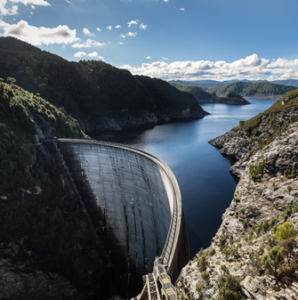
Hydro is operating in a changing environment with new challenges.
When Hydro Tasmania’s chief executive recently offered to meet and discuss the issues raised in my two recent Talking Point articles and the 18 chapter Hydro Explainer series on my website, I readily agreed. It was a constructive discussion open, respectful and professional but it also revealed a deeper challenge that goes well beyond Hydro itself.
One area where our understandings diverged was what happens to interstate trading returns once Basslink becomes a regulated interconnector on July 1, 2026. It sounds technical, but the implications are anything but. For the past two years, interstate price differences have been a major source of Hydro’s revenue. Under regulation, that revenue stream largely disappears. How we understand that shift matters not just for Hydro, but for the state budget and for every Tasmanian who ultimately pays for the system.
The same rules will apply to Marinus.
Hydro has suggested Tasmania will continue to benefit from interstate trading, including when Victorian prices become negative, making imports irresistibly cheap whilst at other times exports will attract high prices due to the closure of coal-fired generators.
These claims sound appealing but is not how a regulated framework works. All interstate trading proceeds under regulation favourable or unfavourable are pooled by Australian Energy Market Operator. Before Hydro can receive anything through the auction process, that pool must first cover Basslink’s regulated annual allowance of about $107m.
Only if money remains and only if Hydro buys the auction units in a competitive process can any value flow to Hydro.
This is how the National Electricity Rules operate.
Sharp price drops in Victoria do not automatically translate into gains for Tasmania. In many cases, they reduce the amount flowing into the pool. And when the pool falls short of the regulated allowance, network providers, TasNetworks for example and therefore Tasmanian consumers must make up the difference through network charges. That is the regulated model. It is not a criticism of Hydro; it is the reality of the new environment.
If the pool is small or depleted, the cost of Basslink does not disappear. It shifts quietly but inevitably onto households and businesses. That is why it is so important that we have a shared understanding of how the regulated system works. The stakes are too high for ambiguity.
At a common sense level, the whole point of regulating an interconnector is to give its owner a steady, predictable return not to create windfalls for generators on either side. All interstate trading proceeds are used first to fund that regulated return. Only if anything is left over does anyone else benefit. Once you understand that, the idea that Tasmania will profit from sharp Victorian price swings simply doesn’t stack up. The regulated model creates certainty of return to the interconnector owner, not Hydro, and certainly not Tasmanian consumers.
This matters even more when set against Hydro’s forward profit expectations. At our meeting, Hydro noted that storage levels are the highest for this time of year since 2012. In the two years that followed the carbon tax years Hydro recorded underlying profits of $230m and $241m, assisted by exceptionally high inflows in 2014, the largest this century.
Yet the state budget is predicting underlying profits of $423m in 2028/29 nearly double the carbon tax years despite the loss of interstate trading returns, the collapse in Large scale Generation Certificate revenue, before Marinus is operating and in a more competitive national market. That is an ambitious projection. Tasmanians are entitled to understand the assumptions behind it.
But the deeper issue is not Hydro’s profit estimates. It is the broader fiscal environment in which Hydro now operates.
Hydro may have a strong balance sheet. So do TasNetworks, TasWater, TT-Line, TasPorts and even the state government. Local government carries almost no debt. Yet every one of these entities faces the same structural problem: they must increasingly rely on revenue drawn from a Tasmanian customer base whose capacity to pay is already stretched.
The state’s own Fiscal Sustainability Reports make this clear. They show a widening gap between the services Tasmanians expect and the revenue the state can raise. Every government business enterprise is being asked to help close that gap. Hydro is simply the most visible example.
This is the central dilemma: Tasmania cannot simultaneously have high profits, low prices, major capital investment and fiscal repair. Something has to give. And unless we confront that reality honestly, we risk building our energy future on assumptions that cannot hold.
Hydro’s public narrative focuses on its strengths storage, flexibility, trading capability, its balance sheet. Those strengths are real. But they do not change the fundamental arithmetic. For interstate trading to increase, new generation will require long-term underwriting or concessional finance. Even so interconnector owners will capture most of the arbitrage value. The question becomes unavoidable: where will Hydro’s short, medium, and longer-term future profits come from?
If the answer is Tasmanian consumers, then we need to say so openly. If the answer is new market opportunities, then we need to identify them clearly. What we cannot do is assume that the past will simply continue into the future.
Hydro is a critical institution. Its success matters to every Tasmanian. But its challenges are not unique. They are part of a system-wide pattern affecting every major public entity in the state. Acknowledging that reality is not a criticism. It is the first step toward a sustainable path forward.
Tasmania deserves to know what is possible, what is affordable, and what trade-offs will be needed. Hydro has an important role to play in that conversation including explaining how interstate trading via regulated interconnectors will produce the returns it claims.
The Mercury, 3 March 2026