

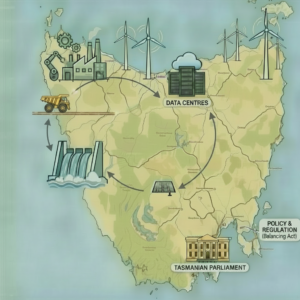
For a small state, Tasmania spends a remarkable amount of energy telling itself what it is about to become: a renewable energy superpower and battery of the nation, a premium food and wine destination, a booming visitor economy, and now, increasingly, a natural home for data centres and artificial intelligence infrastructure.
Every one of these ambitions has merit. Taken together, they are not necessarily compatible – and few are prepared to say so. That is the real gap in Tasmania’s long-term, whole-of-state planning. It isn’t a shortage of slogans from government; it’s a shortage of coordinated, considered planning. A genuine plan would not just describe what Tasmania wants to become; it would name what we are prepared to give up to get there, and who bears the cost.
Instead, we get addition without comprehensive understanding: every new opportunity treated as complementary to everything before it, as if abundant cheap power, heavy industry, agriculture, tourism, population growth and a data-driven economy can all be layered onto the same small grid, the same finite land and water, and the same workforce, without anything having to give. That matters more than ever as Tasmania enters this budget cycle facing fiscal pressures unlike any in recent decades – a narrow revenue base, rising demand for services, and a debt trajectory Treasury itself warns is unsustainable. Pretending every new ambition can just be added, means avoiding not just hard decisions about land, water and energy, but the reality of what the State can actually afford.
Energy shows this first, because it’s where the numbers are hardest to hide. Tasmania built its story on cheap, abundant, water and renewable electricity – first for major industry, more recently as the rationale for Marinus Link and “Battery of the Nation”. That story has quietly changed character: as Basslink shifts to a standard regulated interconnector under Australian Energy Market Operator (AEMO) control, and settlement residues, transmission charges and dispatch increasingly determine who benefits from our generation, the honest answer to “exporter or importer” is no longer straightforward – on any given day, it may be either, or both. That’s not necessarily a problem, but it’s a material change from the story told to industry and the public, and deserves a plan that models it transparently, rather than a Minister’s “least regret” as cover for withholding modelling for Tasmanians to understand.
The recent electricity-price negotiation with Rio Tinto at Bell Bay is this problem in miniature. To retain a major employer, the State must offer internationally competitive power prices – but doing so reduces the revenue available to maintain and upgrade the system that employer relies on. Hydro Tasmania is squeezed between commercial reality and public obligation, while government juggles jobs, regional stability and system sustainability – seeking to deliver critical infrastructure without a revenue base capable of supporting it.
Now layer data centres and AI onto that same grid – pitched as a growth industry suited to our climate and clean energy credentials. But data centres run flat out, around the clock, for decades, far less tolerant of price volatility or curtailment than a mine or a mill. If we genuinely want this investment, someone needs to answer publicly what hyperscale facilities would do to transmission charges, dispatch priorities, prices for existing industry, and our claim to be low-cost once a slice of renewable generation is reserved for offshore-owned AI factories. We cannot sell the same paddock twice – cheap input for manufacturing, scarce premium resource for a new export industry – without checking both promises survive contact with the other.
We also need to be honest about concentration risk. Our economic model has long relied on a handful of major industrials, weakening the State’s bargaining position whenever circumstances change. The emerging data-centre and AI sector carries a similar risk: long-term, inflexible commitments to a small number of global operators could leave us exposed if technology shifts or markets turn. We cannot put all our eggs in one basket when the basket itself is evolving faster than our planning.
This is the tough conversation Tasmania keeps avoiding: we cannot simultaneously be the cheapest energy jurisdiction for industries already here, a booming hub for data and AI, and an exporter earning premium prices. Some combination is achievable. All three, at once, are not. Somebody has to choose – and right now, nobody is being asked to and there is no plan we can consider.
None of this is an argument against ambition. It’s an argument for honesty. So how do we make sure Tasmania is the winner in this next phase, not simply the venue for someone else’s profit?
It starts with insisting new investment demonstrate genuine net benefit to Tasmanians – not a vague jobs commitment, but demonstrable retained value and downward pressure on power prices, across construction and operation. It also requires publishing the modelling behind decisions like Marinus Link’s Whole-of-State Business Case and any data centre power allocation, so trade-offs are argued in public, not settled behind closed doors. We need investment horizons to the true life of the infrastructure, recognising that the discipline missing from our energy planning is the same discipline missing from our fiscal planning. And it means being willing to say no, or not yet, or not like this, however attractive the headline figure looks.
Tasmania has real, durable advantages: a renewable resource base, a workforce we can grow, and a scale small enough that good policy still makes a visible difference. But those only translate into Tasmanians being better off if someone does the unglamorous work of naming the trade-offs, publishing the modelling, and making the hard choice – instead of promising all things to all industries at once.
An honest, transparent approach, with everything on the table, is the only way anyone can tell whether Tasmania actually benefits – rather than simply hosts.