

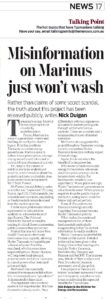
The Record Speaks for Itself: A Response to Minister Duigan
Minister Duigan has again used the Mercury’s opinion pages to characterise my comments and critique of Marinus Link as misinformation. This is the second time he has done so in four months. On both occasions, the rebuttal has relied on misrepresenting what I actually wrote rather than engaging with the substance of the arguments. Tasmanians deserve better than that, and so does this debate.
Below I will address his specific claims directly and against the published record.
On “Speculative”
The Minister puts this word in quotation marks and attributes it to me as a characterisation of interconnector revenue. That is not what I wrote. The word “speculative” appears once across all of my published energy related commentary – in my January 2026 rebuttal to the Minister’s previous opinion piece – and it refers specifically to claims that Marinus will unlock hydrogen production, advanced manufacturing, and new industries. Those claims are speculative because they appear nowhere in the publicly available Whole-of-State Business Case, the Final Investment Decision assessment, or any binding commercial commitment. It has nothing to do with the settlement residue mechanism.
In my April 23 article, the phrase I used was “asset speculation via an auction” – a technical description of the process by which Hydro Tasmania would need to bid at quarterly auction to access inter-regional residue value under the regulated model. Notably, the Minister himself confirms in his rebuttal that price differentials are allocated through settlement residue auctions. That is exactly the mechanism I described. He has confirmed the point while claiming I misunderstood it.
On “Experimental”
The Minister writes that “the regulated interconnector model is not experimental,” implying this is a position I hold. I have never used that word in relation to Marinus or the regulated interconnector model – not in my April 23 article, not in any of the eighteen chapters of my Hydro Explainer, not in the six-part Whole-of-State Business Case series, not anywhere in my published record. The Minister has constructed a rebuttal to a position I have never taken.
On the “Reckless Export Driven Strategy”
The Minister attributes to me the suggestion that Marinus pushes Hydro toward a reckless export-driven strategy threatening Tasmania’s energy security. My April 23 article said the opposite. I reported that Hydro Tasmania itself, in formal correspondence to me following a meeting I attended with Hydro executives, stated it has “no export driven strategy” and describes future exports as merely “plausible.” I was quoting Hydro’s own characterisation back to a government whose public narrative depends on a very different picture. If the Minister believes Hydro’s own words misrepresent Hydro’s strategy, he should take that up with Hydro.
On Briefings and the Source of My Commentary
The Minister suggests that because Hydro, TasNetworks, Treasury, and ReCFIT have briefed me or provided evidence to various committees I sit on, my continued concerns are somehow illegitimate. My April 23 article was not written despite those briefings or hearings – it was the direct product of them. Parliamentary scrutiny exists precisely because ministerial agencies are not infallible, and because elected representatives are expected to interrogate, not simply accept, official narratives. The implication that a parliamentarian should stop asking questions once an agency has explained itself is contrary to the purpose of democratic oversight.
On What the Minister Did Not Address
The Minister’s piece does not engage with the central financial argument I have made consistently across many months of published work: that the $470 million figure attributed to Marinus by the government represents theoretical system-wide benefits modelled across the National Electricity Market, not cash flowing into Hydro’s accounts or Treasury’s coffers. The publicly available Whole-of-State Business Case does not reconcile this figure with Hydro’s revenue, Hydro’s costs, or the State Budget. No published modelling shows the mechanism by which $470 million annually reaches the State’s bottom line. I first raised this in January 2026. The Minister has still not answered it.
He does not engage with the allocation rules for inter-regional residues under northward flows – the core of my April 23 article – nor with the finding in the government’s own Whole-of-State Business Case that Tasmanian wholesale prices rise faster with Marinus than without it. If Hydro’s increased revenue depends on Tasmanian prices rising, that is a transfer from Tasmanian consumers to a state-owned generator. That is not a benefit imported from the mainland.
There are other significant silences. The Minister does not acknowledge that Tasmanian grid electricity consumption is falling – down roughly eight per cent year-to-date this financial year, continuing a structural trend driven by rooftop solar, efficiency gains, and flat industrial load. He does not explain how Marinus can be fully justified without a credible, contemporary demand forecast. He does not address the fact that Tasmania currently has had almost no surplus dispatchable energy to export for most of the year and the business case relies on additional variable renewable anergy to enable Hydro to save water storages to generate into a higher priced market. Nor does he explain how the new generation needed to make Marinus commercially viable will be funded. And he does not engage with the risk that Marinus could lower wholesale prices – good for consumers – while simultaneously reducing Hydro’s profits, which would negatively impact the State Budget. These are not peripheral concerns. They are central to whether the project delivers what has been promised.
On Transparency
The Minister says few projects in Tasmania’s history have been more scrutinised and transparent. The facts tell a different story. The Whole-of-State Business Case was released in heavily redacted form after the government had already signed. The promised thirty days of public review did not occur before the decision was locked in. Basic financial information about Hydro’s revenues and direct costs was refused at Government Business Enterprise scrutiny hearings. These are documented facts, not opinions.
In Conclusion
I want to be clear about where I stand. I have long been a supporter and advocate for Hydro Tasmania. It is one of this state’s greatest assets – the foundation of our renewable energy advantage and a critical pillar of the State Budget. It is precisely because Hydro matters so much that the questions I am raising need honest answers, not personal attack.
Tasmanians are being asked to accept a growing $3.5 billion commitment, with our state of 570,000 people paying 27.6 per cent of a nationally significant project, on the basis of modelling that remains largely redacted and financial claims that have never been publicly reconciled with the Budget. That warrants rigorous scrutiny.
If the government wants to restore confidence in this project, it needs to confront the real questions: Tasmania’s energy balance, the cost of new generation, the potential risks as well and the potential benefits to Hydro’s financial position, and the credibility of the modelling. Across two opinion pieces, the Minister has not done that. He has misattributed words I did not use and mischaracterised arguments I did not make.
Scrutiny of a multibillion-dollar decision is not misinformation. It is exactly what the public interest requires. The full body of my published work on Marinus and Hydro Tasmania is available on my website for anyone who wishes to read what I have actually written.