

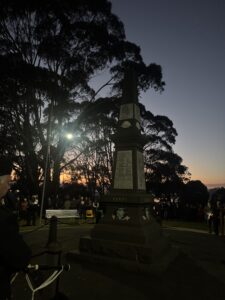
We gather here this morning in the quiet that ANZAC Day always asks of us.
Not just with quiet voices – but quiet hearts. A stillness that lets the past speak and be heard.
That lets us remember those who cannot speak for themselves. And that lets us look honestly at a world where the lessons of their sacrifice must be remembered.
I want to tell you a story this morning. It is a story about three men from this region, and about what one of these men carried home and what, remarkably, he chose not to carry. Whilst this is a personal story, it is a story shared by many here today.
I want to begin with David Emmerton, my Great-Uncle and with a football story.
David was from Stanley. He was the sixteenth child of his family – the youngest, and by all accounts full of life. My father recalls his own father, my grandfather – David’s nephew, saying that David had an excellent drop kick when playing football. Apparently he was a fine player. But he was, in the words used at the time, “chicken-hearted” on the field.
My father said that always made him wonder.
He wondered how David would have felt – as a young man, this footballer from Stanley who lost his nerve on the oval – when he found himself on the battlefields of France. Surely, my father said, a far more terrifying place than any football field.
I have thought about that many times. About the gap between who we are told we are, and what we actually do when the moment comes. About a young man from Stanley who may have been afraid – and went anyway.
Private David Emmerton, Service Number 1800, of the 26th Battalion, was killed in action on the 29th of July 1916 at Pozières, during the Battle of the Somme.
He was twenty-three days into what would become one of the most catastrophic engagements in Australian military history.
On the 23rd of July 1916, the 1st Australian Division saw their first action on the Somme front. They were ordered to take the village of Pozières. What followed was a two-week struggle for a French village and the ridge on which it stood – a battle so ferocious, so costly, that Australian official historian Charles Bean wrote that the Pozières ridge is “more densely sown with Australian sacrifice than any other place on earth.”
Twenty-three thousand Australians lost in six weeks. Twenty-three thousand men, to capture a piece of ground roughly two hundred metres by three hundred metres.
My Great-Uncle, David Emmerton was one of them.
His body was never recovered. Following his death, only a scarf and his pips were returned – sent to his oldest surviving brother Joseph, who lived here in Stanley. His medals, the Victory Medal and the British War Medal, were not sent until July 1921 – by which time his parents, and Joseph too, had all died. They went instead to his eldest surviving brother, Thomas John.
David Emmerton is remembered with honour at the Villers-Bretonneux Memorial, at the War Memorial in Stanley, and at the Australian War Memorial in Canberra, on Panel 107.
Now I want to tell you about George Bernard Mason, from Barrington. George is also my Great-Uncle.
At the time, George was the 19-year-old son of widow Sarah Jane Mason. George assisted running the family farm at Barrington before his mother signed the consent for her only son to go to war in 1916.
I am quite sure that whilst Sarah Jane signed this consent it would have been difficult to ‘let her son go’ with the demands of running a farm at such times as a widow.
George enlisted on the 5th of October 1916 and sailed for the Western Front with the 40th Battalion. He was sent to Flanders. In June 1917, the 40th Battalion fought at Messines. In October, they were part of the Battle of Broodseinde Ridge – costing Australia alone six and a half thousand casualties in a single engagement.
George was wounded on the 6th of October 1917 and died of those wounds at the 2nd Anzac Casualty Clearing Station in the field in Belgium. He is buried in Ypres in Belgium. I have visited his grave which sits among so many.
He died one year and one day after he had enlisted. Back home in Barrington, his family including his sister Edna, waited for news and sadly received the news that no family wants to get.
Now I want to tell you about my grandfather – David’s nephew, and the man who would one day bring these two families together.
William James Emmerton enlisted on the 12th of April 1916 and went to the Western Front. On the 31st of January 1917, he was wounded in action in France – he had septic abdominal wounds received when a shell exploded in the trenches that actually resulted in the butt of his rifle that he was holding at the time completely cut off with shrapnel entering his abdomen. He was evacuated to England and admitted to Edmonton Military Hospital.
For many men, a wound that serious would have meant the end of their service. But William recovered. On the 24th of August 1917, he returned to France. On the 1st of September 1917, he marched out to join the 40th Battalion – the same battalion in which George Mason was serving.
They were now side by side – in the same mud, under the same guns, in the same desperate weeks of the Flanders offensive.
Five days after George Mason died of his wounds, on the 13th of October 1917, William Emmerton was reported missing.
He was identified the following day as a prisoner of war – captured during the very same Broodseinde [Brood -signed] offensive that had killed George Mason – and interned at Friedrichsfeld bei Wesel, in Germany.
He would remain there until the end of the war.
My Grandfather William did not speak much about the war when he finally came home. That was common to men of his generation and experience – men who had seen things that words seemed inadequate to explain the full horror of their experiences.
But there was one thing he did speak about. And I think it is worth saying here today, because it tells us something important about who he was.
He told my dad that he held no hatred for his captors, the Germans.
The prison guards, he said, were generally kind men. They were also starving. Whatever food they had, they shared with their prisoners. Many of the younger men in the camp died – mostly from starvation and dysentery. William watched them go.
He said that he and the others who survived owed their lives to the Red Cross – to the food parcels that eventually reached them.
No hatred. Even after the wounds in France. Even after the capture. Even after more than a year watching young men die around him in a German prison camp. He came home weighing roughly half of what he had weighed when he left.
When the guns fell silent on the 11th of November 1918, William Emmerton was still behind wire in Germany. He would wait another seventeen days before he could leave.
William was repatriated to England on the 28th of November 1918 and admitted to Fulham Military Hospital. He embarked for Australia from Portland on the 3rd of March 1919. He was honourably discharged on the 23rd of June 1919, with the formal acknowledgement that he had served with honour – and that he had been disabled in the Great War.
On ANZAC Day, the 26th of April 1924, he was awarded the British War Medal and the Victory Medal.
William James Emmerton died in June 1958, at the age of 79, at Riana – where I grew up but I sadly never met him. He had left his home at Riana as a young man and to which, against all odds, he had returned.
And this takes me back to Edna. George Mason’s sister.
After the war, William met and married Edna Mason. The sister of a man he had fought alongside and a comrade who did not return. They did not know each other before the war which reminds us so many of us are connected through shared history and experiences
And I am their grandchild.
I have stood at ANZAC Day services for many years thinking about what it means to carry that history in your own blood. Two families – the Emmertons and the Masons – bound together first by war, and then by love.
Edna lost her beloved brother George to the 40th Battalion, and then she built her life with a man who had served beside him at the end. A man who had survived what her brother had not, and who came home a shadow of his former weight, carrying things he would spend the rest of his life mostly not speaking about.
There were many women who waited at home – grandmothers, mothers, sisters, wives, finances and girlfriends. Waiting and hoping the dreaded telegrams were not delivered to their doors. Feeling relief when they weren’t but often guilt that their loved ones returned when so many didn’t.
We also need to remember the loss and heartbreak of those who lost loved ones as a result of this and subsequent conflicts. Behind every conflict – including those playing our today where men and women put their lives on the line for our future, for our security and for our freedom – there are humans with hearts that can be broken and pain this is enduring.
One hundred and eleven years have passed since Gallipoli.
And yet this morning, as we stand here, there are families in Ukraine who have not seen their fathers or sons in months – and do not know if they ever will again.
There are people across the Middle East living in the rubble of wars the world watches and continues.
And there are Australian men and women serving right now in some of the most complex and dangerous environments our forces have ever navigated – not in one clear war with clear enemies, but in a fractured world where threats are multiple and the rules of engagement are contested and the toll on those who serve – physical, psychological, moral – is immense and often invisible.
In the new world of AI and drones used in warfare, long range missiles and so it, it is not easy to know where the enemy may be coming from and it is unlikely they would even see them.
These brave men and women put on a uniform knowing what this era looks like. They deserve our respect, our attention, and our support, not just today, but every day.
But as we look back today and reflect on past conflicts I return to the humans behind the names, their families, friends and loved ones.
And I think about William Emmerton watching young men die in a German prison camp, and still finding it in himself to see the humanity of the guards who were also hungry, also afraid, also far from home.
I think about what it takes to carry that kind of grace back from a place like that. And when my own father asked my grandfather what he felt at the outbreak of WW2 – his reply – ‘oh well son, at least we have had 30 years of peace’.
And I think it is the most important thing I can offer this morning – not just remembrance, but the question his life asks of all of us.
In a world that is once again fracturing along old lines of fear and nationalism and violence – what do we choose to carry home and into our lives?
David Emmerton did not come home from the Somme. George Mason did not come home from Belgium. William James Emmerton came home to Riana, and met, fell in love with and married my grandmother Edna, and lived a life that held both grief and gratitude.
My grandfather held no hatred. Not for the mud, the wounds and the hunger. Not for the men who put him behind wire. Not for the years of his life that were taken from him and never given back.
Thankfully, he came home. And loved. And lived. He raised children, including my father.
I am his granddaughter, standing here on the land he came back to. I carry his story in my heart and share it when it can shed light. I carry it into arguments about a world that is once again seeing peace at real risk.
With all he experienced and survived, far more than I am ever likely to, I hope I can be half as forgiving. I hope I can be half as brave.
Lest we forget.